
Repeace Research Compendium

(in progress. stand as of Sept 2025)
Essential Thinkers, Quotes, and References Behind the Architecture of Repeace
Preface: Why This Matters
Something is broken—and it isn’t just politics, media, or capitalism. It’s our entire conception of how resistance works.
This compendium was born from years of frustration and insight. From failed uprisings and disillusioned heroes. From protests crushed, narratives hijacked, and identities fragmented. It draws from the thinkers who dared to name the dysfunction, the whistleblowers who paid the price for truth, and the scholars who saw the cracks in our culture before most would admit they were there.
Repeace does not add another movement to the pile. It proposes a new architecture of dissent—measurable, unified, strategically immune to co-option. This research scaffolds that vision. What follows is a curated archive of voices, frames, and failings that illuminate why peace (as it’s currently understood) is insufficient, and why a new semantic, psychological, and strategic identity—repeace—is needed to organize human dignity at scale.
Zone I: The Crisis of Activism
“Everything We Tried Didn’t Work. Here’s Why.”
-
Roger Willemsen
Call for a new form of dissent based in social science competence.
-
Conventional Dissent
Political, legal, populist, and academic forms no longer pose real threats.
-
Protest is Dangerous
Increasing police brutality and criminalization of even peaceful actions.
-
Organizers Harassed
Activists face defamation, arrest, and surveillance.
-
Rainer Mausfeld
Loss of identity in modern movements due to neoliberal fragmentation.
-
Alberto Melucci
Emphasizes the role of identity in building collective action.
-
Jules Boykoff
How mass media frame dissent: freaks, ignorance, disruption.
-
Anonymous U.S. Professor
Academics fear political association; prefer silence.
-
Howard Zinn
True resistance requires going against even one’s own group.
-
Albert Einstein
Absurdity is often the seed of revolutionary truth.
-
Marty Kaplan
The problem isn’t just misinformation; it’s the absence of public accountability. Repeace reframes this void with civic integrity and pledges as currency. (here)
-
Charity Navigator — The Gamification of Trust
Originally designed to bring transparency to nonprofits, Charity Navigator quickly reshaped how activism itself was judged. By prioritizing financial ratios over mission outcomes, it reinforced the idea that “responsibility” is a matter of budget optics, not structural courage. Organizations tackling injustice often scored lower, as systemic change defied spreadsheet logic. Charity Navigator became a kind of moral shopping mall—inviting citizens to “feel responsible” without ever engaging their convictions. Repeace offers a reversal: a semantic marketplace of integrity, not a scoreboard of conformity.
Zone II: The Weaponization of Language and Perception
“When Peace Means Nothing: The Hijacking of Language”
-
Bertrand Russell
Popular opinion can be absurd; peace/war definitions must be challenged.
-
Noam Chomsky
Stop looking for heroes; start generating new ideas.
-
Bonhoeffer, Shaw, Maxwell
The problem isn’t malice, but stupidity and apathy.
-
There Is No Peace
Endless military engagement, failed treaties, nuclear escalation.
-
The Peace Movement is Gone
Activists and academics agree on its ineffectiveness.
-
Dahr Jamail
Anti-war veterans disillusioned, movement collapse due to fragmentation.
-
Maureen Dowd
From sharp satirist to safe stylist. Her evolution reflects the fate of many mainstream progressives who chose wit over rupture, leaving true progressives without a principled narrative sword.
Zone III: Why the People Never Rise
“We Weren’t Built to Resist—But We Can Be Rewritten”
-
Ronnie Kasrills
Need to define the true enemy and what must be replaced.
-
Buckminster Fuller
Build models that make old systems obsolete.
-
Gar Alperovitz
Calls for evolutionary reconstruction, not protest or revolution alone.
-
Sheldon Wolin
“We need a new word for revolution.”
-
John Ralston Saul
Liberal reformers failed; need coherent, professional dissent.
-
Wolfgang Streeck
“We” decide nothing; elites govern through opaque markets.
-
George Lakoff
Occupy was moral, not policy-based; framing must be ethical.
-
Malcolm X
You can’t organize without attention; self-interest undermines collective unity.
-
JFK
Peace is not the absence of war; it’s a process of institutional reform.
Appendix: Source Index and Search Terms
All references will be linked here for academic citation and cross-referencing.
old detailed input:
The Repeace Research Compendium
References:
1. Roger Willemsen
-
Reitschuster.de (old lady at Querdenker Demo): https://reitschuster.de/post/stadt-droht-spaziergaengern-mit-waffengewalt/
-
UN SDG Goal 16 Report: https://unstats.un.org/sdgs/report/2019/goal-16/
-
Justice for Colombia: https://justiceforcolombia.org/news/one-social-activist-murdered-on-average-every-18-hours-in-2020/
2. Prof. Dr. Rainer Mausfeld
-
YouTube (lecture): https://www.youtube.com/watch?v=-hItt4cE0Pk
3. Alberto Melucci
-
Book: Melucci, A. 1995. Social Movements and Culture. University of Minnesota Press
4. Prof. Jules Boykoff (Framing)
-
Framing Dissent: https://www.tandfonline.com/doi/abs/10.1080/07393140600679967
5. Howard Zinn
-
A People's History of the United States (1980).
6. Albert Einstein
-
Quote: "The definition of insanity..." (widely attributed).
7. Bertrand Russell
-
Image reference: images/stories/articles/bertrand-white.png
8. Noam Chomsky
-
Quote: “We shouldn’t be looking for new heroes, but for new ideas.”
9. People are stupid: Shaw, Maxwell, Bonhoeffer
-
Bonhoeffer essay: https://matiane.wordpress.com/2021/02/23/dietrich-bonhoeffer-stupidity-is-a-more-dangerous-enemy-of-the-good-than-malice/
10. The Framing Fraud – There Is No Peace
-
Nick Turse: http://www.tomdispatch.com/post/176048/tomgram:_nick_turse,_a_secret_war_in_135_countries/
-
Consortium News (terror): https://consortiumnews.com/2022/01/06/the-war-on-terror-is-a-success-for-terror/
-
Europe war patterns: https://www.youtube.com/watch?v=oWWLECJnylM
-
Israeli-Palestinian conflict: https://unsco.unmissions.org/un-report-lack-progress-resolving-israeli-palestinian-conflict-impedes-palestinian-development
-
Nuclear disarmament (5 links, see doc)
-
MLK inequality poll: https://www.yahoo.com/news/poll-50-years-mlk-apos-214928847.html
10b. No Peace Movement
-
Telegram image: images/stories/articles/telegram-frieden-leer.jpg
-
Dissent: https://www.dissentmagazine.org/article/michael-kazin-why-no-antiwar-movement-iraq
10c. Escalation Confirmed
-
UCDP Conflict Data Program: https://ucdp.uu.se/
-
ACLED Conflict Index: https://acleddata.com/
-
SIPRI Military Spending: https://www.sipri.org/
11. All Conflicts are Wars (Information/Democracy/Dissent, etc.)
-
Truthdig: https://www.truthdig.com/articles/americas-war-on-dissent-began-a-century-ago/
-
Consortium News: https://consortiumnews.com/2015/09/28/the-power-of-false-narrative/
-
McLuhan InfoWar: https://mcluhangalaxy.wordpress.com/2015/01/26/marshall-mcluhan-predicted-the-emerging-infowar/
-
Facebook: https://www.blackagendareport.com/facebook-not-your-friend
-
Scott Ritter on free speech: https://consortiumnews.com/2022/08/03/scott-ritter-chuck-schumers-war-on-free-speech/
-
War on democracy/class war: (14+ links – see doc; e.g. Chomsky, CommonDreams, Alternet)
-
War on dissent: https://ratical.org/co-globalize/NLG-REPORT.pdf (others, see doc)
-
War on journalism: https://trofire.com/2016/10/13/documentary-filmmaker-faces-45-years-prison-covering-pipeline-protest/ (others)
12. Victor Hugo
-
Quote attribution: “Nothing is more powerful than an idea whose time has come.”
13. Sun Tsu
-
The Art of War
13b. Keith Olbermann
-
Quote on digital communication as weapon.
14. Rumi
-
Weisewortwahl: http://weisewortwahl.de/tag/Mevlana-rumi-zitate
15. Daniel Ellsberg
-
StopWatchingUs video (2013): https://www.youtube.com/watch?v=TjAqnxhmpwo
15b. Gustav Viktor Śmigielski
16. Martin Luther King
-
Quote: “Those who love peace must learn to organize as effectively as those who love war.”
17. Gandhi
-
Quote: “The enemy is not hate, but fear.”
17b. Prof. Julie Ponesse
18. Michael Manley
19. Chris Hedges
20. Ronnie Kasrills
21. Buckminster Fuller
-
Quote: “You never change things by fighting the existing reality…”
21b. Gar Alperovitz
22. Prof. Sheldon Wolin
-
Wikipedia: https://en.wikipedia.org/wiki/Sheldon_Wolin
23. Prof. John Ralston Saul
24. Wolfgang Streeck
25. Prof. George Lakoff
-
Framing memo: https://georgelakoff.com/2011/12/11/how-to-frame-yourself-a-framing-memo-for-occupy-wall-street/
26. Malcolm X
-
Collected speeches (see doc).
27. John F. Kennedy
-
Commencement Speech, 1963: https://www.jfklibrary.org/archives/other-resources/john-f-kennedy-speeches/american-university-19630610
28. Eve Ensler
-
Image reference: images/stories/articles/eve-ensler.png
29. Alice Walker
-
Quote: “Activism is the rent I pay to live on this planet.”
30. Jane Goodall
-
Quote: “The greatest problem of humanity is apathy.”
31. Willie Nelson
-
Quote: “Participation will save humanity.”
31b. Dwight Eisenhower
-
Quote: “People will simply ‘take’ peace.”
32. Prof. Arie Kruglanski
-
Cognitive closure: https://www.openculture.com/2016/11/theory-of-cognitive-closure.html
33. Michael Yeadon (ex VP Pfizer)
-
Quote: “Something unexpected must happen…”
34. Stanley Milgram / Patrick Haggard
-
Obedience to Authority (1974)
-
Current Biology Journal: https://doi.org/10.1016/j.cub.2015.12.067
35. Peter Singer
-
Corporate Warrior: The Rise of the Private Military Industry
Links Index from the German version:
(This list makes no claim of accuracy or completeness)
1. Roger Willemsen. (German publicist and author)
What is needed, with a certain urgency, is a new form of dissent, that comes from the expertise of those who are competent in the realm of social sciences. (The comment comes from a lecture, a speech. The video is unfortunately no longer available on YouTube).
1b. The "normal", the "usual" is of no use. Conventional methods and channels of dissent are not a new form of protest..
Conventional methods of dissent include populist, political, legal, whistleblowing, academic, multimedia, or "hybrid" forms. They no longer pose a real threat to the power structures and those who point the finger at the establishment, risk too much.
Methods, expressions of national / international resistance. Examples:
- Populist Resistance Movements: Occupy Wall Street, Gilets Jaunes, Podemos, Corbyn movement, Solidarność, Movimento 5 Stelle, Querdenken711, large workers’ and suffragette movements.
- Political Movements and New Parties: Widerstand2020, Die Basis, Team Freiheit, Pirate Party, US Green Party, various independent and grassroots political actors aiming to bypass traditional party systems.
- Legal Challenges and Constitutional Initiatives: NDAA challenges, Corona Ausschuss, Freunde der Verfassung, strategic lawsuits, citizen initiatives to reclaim constitutional governance.
- Whistleblowers and Investigative Resistance: Wikileaks, Project Veritas, Snowden, Assange, Chelsea Manning, initiatives aimed at exposing hidden truths to ignite public outrage and reform.
- Multimedia Education and Alternative Journalism: Authors, historians, documentary filmmakers, podcast networks, independent journalists on Substack, Rumble, YouTube; seminars, independent publishers—all platforms aiming to spread awareness and reframe mainstream narratives.
- Digital and Social Media Activism: Memetic warfare, viral campaigns (hashtags like #MeToo, #FridaysForFuture), digital protests, awareness explosions through platforms like Twitter, Telegram, Reddit activism hubs.
- Decentralized and Anonymous Resistance Networks: Anonymous collectives, blockchain-backed activism, decentralized autonomous organizations (DAOs) for political or protest purposes (early-stage trend but growing).
- NGOs and Nonprofit Structures: Millions of NGOs are a part of an expression and method intended to organize public concerns and lead to solutions through engagement and public donations. However, millions of NGOs have largely failed activists; tiny successes are magnified for fundraising while larger NGOs often serve political purposes. Good NGOs are submerged in a swamp of corrupt organizations that dominate and divide public attention.
1c. Protesting and demonstrating is not only dangerous, it can also be deadly.
On August 14, '22, Reitschuster.de reported on an old lady who died after the Berlin police brutally attacked her (Querdenker Demo). But not only peacefully demonstrating, even meditating, praying, singing, and walking are, according to the government, unreasonable forms of protest. It's not as if "activists" in other countries haven't been thinking about it for decades, trying every form of peaceful resistance, respectful of law amd order.

This point needs little proof. A totalitarian state and an eltes' controlled State does not shy away from using extreme violence and all forms of intimidation at the most peaceful of gatherings, and a subservient corporate run Media is always ready to incite the public and blame "activists" for any escalation. Numerous elderly people have been injured at demonstrations. (Jan - October 2018) An average of nine people were murdered each week on the front lines of the effort to build more inclusive and equal societies – a disturbing increase from the average of one victim per day from 2015 to 2017. (here)
- - https://justiceforcolombia.org/news/one-social-activist-murdered-on-average-every-18-hours-in-2020/
- - https://www.bbc.com/news/science-environment-58508001
1d. People who organize and call for peaceful demonstrations are arrested, defamed, and extremely harassed.
External Suppression of Activism
From Occupy Wall Street to COVID-era dissent, the evidence is overwhelming: activism fails not only from within (fragmentation, burnout, lack of identity), but from deliberate external chokeholds. State and corporate power deploy a four-tier spectrum of suppression:
-
Physical Force: police militarization, riot control, kettling, “non-lethal” weapons.
-
Psychological Warfare: infiltration, agent provocateurs, discreditation campaigns.
-
Digital & Media Suppression: social media bans, shadowbanning, coordinated smear narratives.
-
Structural/Economic Strangulation: deplatforming entire networks, financial account closures, denial of infrastructure.
From the militarized response to Occupy Wall Street in 2011, to the wholesale deplatforming of Parler in 2021, to the freezing of accounts of independent publishers like RT, TRNN, KenFM, or AUF1, the pattern is consistent. What begins with batons and tear gas ends with algorithmic ghosting and banking blacklists. The architecture of power has learned to suffocate dissent across every layer — from the street, to the screen, to the financial bloodstream itself.
This suppression confirms the need for a structural correction. A movement that is not dependent on NGOs, funding pipelines, or centralized gatekeepers cannot be deplatformed in the same way. By anchoring resistance in semantic clarity and universal pledges, Repeace offers a form of solidarity that is both more fluid and less chokeable.
2. Prof. Dr. Rainer Mausfeld
Professor Mausfeld (and many other social psychologists) talk about something of great relevance in social resistance, namely the role of identities. He reminds us of the disintegration of the workers' movement:
Through false identities, neoliberalism had uprooted the workers' movement from its own history of solidarity movements. The workers' movement suffered a loss of memory, and therefore it has a loss of identity. The identity on which all workers' movements arose (May Day) is gone, it is no longer available... We are atomized and uprooted... so, the social power for change is lacking. That was precisely what neoliberalism planned.
The power structures have very central characteristics:
- They are not democratically legitimized and cannot be voted out (they are not accessible to individual voters).
- They are exempt from any public accountability.
- They are invisible in the public discussion space.
- They are merged with state organizations and the merger is legalized. (here)
3. Alberto Melucci
All emancipatory attempts to mobilize and direct the energy of social change are without exception identity-related (they need a name) and are based on existing values, images and associations in order to create a new frame. The central role of identities is known from a social psychological perspective. It is accepted as a fundamental condition for the elusive feeling of "WE" (collective consciousness).
- Melucci, A. 1995. Social Movements and Culture. University of Minnesota Press.
4. Prof. Jules Boykoff (Framing)
In mainstream mass media, activism, resistance or dissent is intentionally and consistently framed negatively. It is not advantageous to identify with this name/brand.
- Framing Dissent: Mass-Media Coverage of the Global Justice Movement (here)
The study by Prof Jules Boycott of Pacific University showed how the mainstream mass media in the United States uses framing techniques to negatively portray activism and activists. The coverage of the "Global Justice Movement" movement was analyzed during two major points of contention: the World Trade Organization protests in Seattle in 1999 and the World Bank/IMF protests in Washington, D.C. in 2000.
A content analysis resulted in five predominant images:
- the Violence Frame
- the Disruption frame, (disruptive)
- the Freak frame, (crazy)
- the Ignorance frame (ignorant)
- the “Amalgam of Complaints” frame/framework.
These frames arise from the interactive relationship between social movements and mass media, which is limited by journalistic norms and values, and leads to a dialectic of escalation in which activists feel compelled to radicalize their tactics and rhetoric as they seek the attention if they want to attract mass media attention.
Quote from anonymous U.S. Professor on the topic of activism:
Most people I know in academia try not to be too closely associated with activism... a Google search makes your politics so obvious. If academics see your name being associated with a group, it can jeopardize your status, at least to the point where you have tenure, then you're generally safe. My activism at this point is mostly related to monetary donations, since that doesn't make a lot of headlines. I hope that this will change at some point in the future, but I am also so skeptical that I hesitate to attach my name to a movement because it can always fail me in its values and actions one day.
5. Howard Zinn
Howard Zinn ⇧ needs no introduction in the area of social change or in peace research. Zinn's best-known work is the extensive A People's History of the United States, which was published in 1980 and became a bestseller. Howard Zinn suggests that "changing things radically" often means going against the grain, and not just against the prevailing opinion of the establishment, but also against the prevailing normality within one's own group.
6. Albert Einstein
Albert Einstein's theories were met with resistance as the theory of relativity was seen as a direct challenge to the widely accepted theory. His idea was also derided as “completely impractical and absurd.” History is full of examples that show that radical new ways of thinking and insights emerged against the dominant opinion of one's own group. Einstein went so far as saying that absurdity was a required attribute of any new great idea, hence telling us all to carefully look into ideas that sound crazy.
Those who first suspected that the Earth was round, that the continents were once connected, or that the Milky Way was just one of 2 trillion galaxies in the universe were considered crazy and their ideas absurd. Visionaries physicists, biologists, anthropologists or geologists have often had to debate and argue very passionately with their own colleagues to be taken seriously.
The famous quote: "The definition of insanity is doing the same thing over and over again, expecting different results," shows that there comes a point when change is forced upon a thinking that has become obsolete. When the rationale for its significance become weak, the shift becomes inevitable. The "radical" in all radical, revolutionary change is given by the widening gap between old assumptions and new ideas. It's always a sort of SNAP! an AHA!-moment, a "I never thought of looking at that from this angle!"
7. Bertrand Russell
There are many prevailing opinions that are absurd. British philosopher Bertrand Russell ⇧ also emphasized that the fact that an opinion is widely held is not evidence that it is not completely absurd.
8. Noam Chomsky
We shouldn't be looking for new heroes, but for new ideas.
9. People are stupid: George Bernhard Shaw; Jordan Maxwell; Dietrich Bonhoeffer.

People are stupid. They are ignorant, ill-informed, unread, self-centered, selfish, materialistic, and they don't care. -- Jordan Maxwell
Stupidity is a more dangerous enemy of the good than malice. One may protest against evil; it can be exposed and, if need be, prevented by use of force. Evil always carries within itself the germ of its own subversion in that it leaves behind in human beings at least a sense of unease. Against stupidity we are defenseless. Neither protests nor the use of force accomplish anything here; reasons fall on deaf ears; facts that contradict one’s prejudgment simply need not be believed–in such moments the stupid person even becomes critical–and when facts are irrefutable they are just pushed aside as inconsequential, as incidental. In all this the stupid person, in contrast to the malicious one, is utterly self-satisfied and, being easily irritated, becomes dangerous by going on the attack. For that reason, greater caution is called for when dealing with a stupid person than with a malicious one.
Never again will we try to persuade the stupid person with reasons, for it is senseless and dangerous. If we want to know how to get the better of stupidity, we must seek to understand its nature -- Dietrich Bonhoeffer
also: Theory of stupidity, here:
10. "There Is No Peace" – The Framing Fraud
- - There is no idealized peace (here)
- - The war on terror is a success... for terror (here)
- - Europe shows a constant pattern of war (here)
- - There is no progress in peace," (here, here here here or here);
- - Nuclear disarmament is a myth [1],[2],[3],[4],[5];
- - Poll: 50 Years After MLK's Assassination, Most Americans Think Inequality Reigns (here);
- - In 2018, the U.S. Is Even More Gilded Than in 1918 (here).

10b. There is no "peace movement." Manufactured Dissent – Resistance as Ritual, Not Remedy Even righteous protests are absorbed into a system that has mastered pacification. The cycle of outrage and resignation benefits the status quo.
- - Peace movements have become irrelevant. (here)
- - America Needs a New Peace Movement (here)
- - Why Is There No Antiwar Movement? (here)
Also:
Quote from a U.S. Author on the topic "Peace Movement:'
After hard work in the anti-war movement in the USA between 2002 and 2010 and direct involvement in several of the leading organizations (Veterans against War, IVAW, PSR, Code Pink, etc.), I have come to believe that the USA is physically/psychologically/spiritually / intellectually/ psychologically so fractured that it is impossible to have a coherent movement of any kind. I myself have moved away from direct activism and now rely solely on my writing...it is my personal vehicle for change and what I do to stay sane during these crazy times.
10c. Escalation Confirmed – A Historical, Empirical Case
Global Harmony and Responsibility Are in Decline
Despite decades of diplomatic rituals and institutional lip service, the world is measurably moving away from peace, cooperation, and global responsibility.
- Armed conflicts are at post-WWII highs. In 2023, the Uppsala Conflict Data Program (UCDP) reported 59 active state-based conflicts—the highest since 1946.
- Conflict complexity is intensifying: internationalized intrastate conflicts (civil wars with foreign involvement) have increased nine-fold since 2004.
- The ACLED Conflict Index recorded nearly 200,000 conflict events in 2024—up from ~104,000 in 2020.
- Global military spending hit $2.718 trillion in 2024—marking the tenth consecutive year of growth.
- The military share of world GDP reached 2.5%, the steepest post-Cold War rise in decades.
- Displacement is surging: over 117 million people were forcibly displaced in 2023, the highest number ever recorded.
Conclusion: The world is not evolving into a responsible, peaceful order. It is fragmenting under the weight of unaccountable militarism, war proliferation, and humanitarian failure.
This is not a phase. It is a direction.
It is the arc of a species that has yet to decide whether it wants to survive as a collective—or compete itself into oblivion.
11. All Conflicts are wars, for good reasons:
War of Information. War of Narratives / Censorship
- - America’s War on Dissent Began a Century Ago. (hier)
- - The Power of False Narrative: (hier)
- - What we are experiencing here is an information war. It is a battle for people's consciousness. (here -Telegram)
- - Marshall McLuhan: „The real, total war has become an information war" (here)
- - It's an information war (here -Telegram)
- - Facebook is not your Friend (hre)
- - Chuck Schumer’s War on Free Speech (here)
War on Democracy
- - The Great American Class War
- - The struggle over health care in the United States is a form of class warfare
- - Chomsky: Business Elites Are Waging a Brutal Class War in America
- - The Feds Have Turned America Into a War Zone: 4 Disturbing Facts About Police Militarization
- - 14 Reasons Why House and Senate Republicans Have Declared Economic War On Average Americans
- - Call It What It Is: A Class War
- - The Bitter Consequences of Corporate America's War on Unions
- - The War On Democracy (English subtitles)
- - The war on democracy: How corporations and spy agencies use "security" to defend profiteering and crush activism
War against dissent
- - Forget about the militias. The feds are now targeting the anarchists
- - Report Finds Police Worldwide Criminalize Dissent, Assert New Powers in Crackdown on Protests- -
- - https://occupywallst.org/article/war-on-dissent/ (currently not available)
- - When the Government Views Its Own Population as the Enemy
- - The Saga of Barrett Brown: Inside Anonymous and the War on Secrecy
- - The War on Whistleblowing (here)
- - US ‘waging war’ on whistleblowers
- - The DOJ's creeping war on whistle-blowers
War against African Americans
- - http://www.commondreams.org/views/2015/05/18/civil-war-rages-black-america
- - http://www.aljazeera.com/indepth/features/2014/11/ferguson-resembles-war-zone-after-ruling-201411266462652277.html
- - http://www.counterpunch.org/2015/04/09/the-war-on-black-america/
- - https://www.commondreams.org/news/2014/11/12/ahead-grand-jury-announcement-are-ferguson-police-getting-ready-war
War against Universities ⇧, Health ⇧
War against journalism
- - Documentary Filmmaker Faces Up to 45 Years in Prison for Covering Pipeline Protest (here)
- - There is a War on Journalism”: Jeremy Scahill on NSA Leaks & New Investigative Reporting Venture (here)
- - Leaked Video Reveals Amazon’s Belligerent Anti-Worker Tactics (here)
War against our young ⇧
Other wars:
- - http://www.counterpunch.org/2016/04/12/the-war-on-savings-the-panama-papers-bail-ins-and-the-push-to-go-cashless/
- - http://www.commondreams.org/news/2015/06/03/facing-government-crackdown-greenpeace-india-refuses-be-intimidated
- - https://www.theguardian.com/environment/true-north/2017/jul/17/neoliberalism-has-conned-us-into-fighting-climate-change-as-individuals?CMP=share_btn_tw
- - http://www.theguardian.com/environment/ng-interactive/2015/jun/16/drilling-oil-gas-arctic-alaska
- - http://www.globalresearch.ca/a-sinister-war-on-our-right-to-hold-cash/5605138
- - http://www.businessinsider.de/jean-ziegler-warnt-der-dritte-weltkrieg-hat-laengst-begonnen-2017-3?IR=T
12. Victor Hugo
The French poet and writer is credited with the following: "Nothing is more powerful than an idea whose time has come." Much of his original French work had more to do with shifts from the battlefield to an arena of thought open to ideas. But now his writings may be coming to life - through effective, collaborative work. During the time of the Occupy Wall Street protests, online social media communities used this quote a lot, confident and hopeful that “Occupy”, “Anonymous,” or "The Zeitgeist movement," were THE idea alluded by Hugo.
13. Sun Tsu
The art of war is about overwhelming the enemy without fighting. Preventing our defeat is in our own hands. But the opportunity to defeat our opponent is provided to us by our opponent.
13b. Keith Olbermann
We need to recapture the energy and purpose of the 1960s and 1970s. We must rise up nonviolently but persistently... in a modern version of that resistance, facilitated and strengthened by a weapon our predecessors did not have: the power of digital communication."
14. Rumi
Not those who speak the same language understand each other, but those who share the same feeling. (here)
15.Daniel Ellsberg ⇧
“I can't blame people if they feel that protests achieve nothing.” In 2013, at a demonstration for Edward Snowden (StopWatchingUs, here um 1:00) Daniel Ellsberg (Vietnam Papers)”
“In 2003 we had the largest demonstrations in world history against the US wars of aggression against Iraq. 15 million people worldwide protested in February 2003 and nothing happened. I can't blame people if they feel like protests aren't accomplishing anything.”
15b. Gustav Viktor Śmigielski ⇧
Journalists and other authors produce a lot of critical articles about our society and the organizations that control it. We briefly get upset about their behavior, maybe feel morally superior at times, but basically nothing changes. It's worth looking at the news from 30 years ago - the parallels to today are frightening. Perhaps it has come to this because we rarely debate alternatives and rarely break out of entrenched patterns of thought. In many cases, we still cling to the naive belief that something will change for the better if we collectively - armed with cardboard signs and slogans - make our displeasure known in the streets. What's needed is new ideas that can help change our society. It's about creating an image of the future we want to live in. We then have a plan in mind, a goal that needs to be discussed and perhaps achieved. The more precisely we define this, the more clearly we can see the paths that lead there.
16. Martin Luther King
“Those who love peace must learn to organize as effectively as those who love war”
17. Gandhi
"The enemy is not hate, but fear."
17b. Prof. Julie Ponesse ⇧
"Almost everyone lacks courage"
How many people believe they would have resisted historically unjust systems? Most do. And how many are truly capable of doing so when things get serious? Very few. Contemporary social experiments demonstrate this. True courage is apparently a rarity. But it is also a potential that each of us carries within us. The challenge for social resistance and new forms of dissent is to lower the threshold of courage so that people can express dissent effectively, without risking repression, violence, discrimination, and much worse.
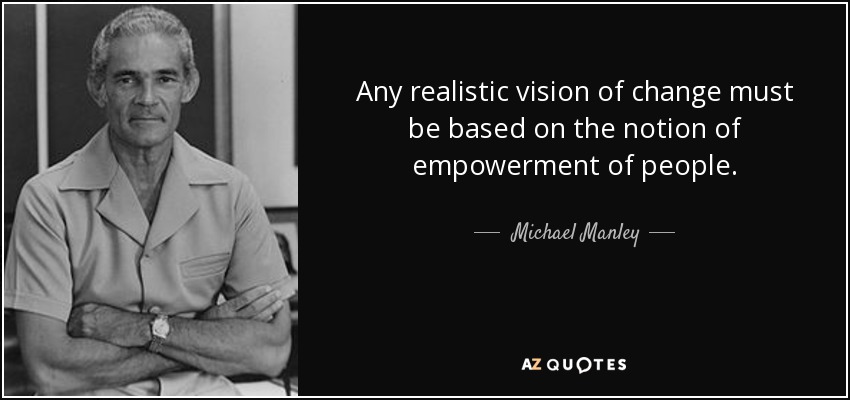
18. Michael Manley
Any realistic vision of change must be based on the notion of empowerment of people. ~Michael Manley (hier)
19. Chris Hedges
None of the largest emancipatory movements in the United States had significant democratic impacts, but merely created "openings" in the democratic process. (...) The liberal class functions within a system of capitalism that grants just enough reforms to keep the underclass submissive.(⇧ here at 27:00-31:00)
Here Also Rainer Mausfeld, "There is an arsenal of techniques to disrupt movements."
and, quote from an anonymous U.S. professor on the possibility of a successful revolution:
und, Zitat von anonymen U.S. Professor über die Möglichkeit einer erfolgreichen Revolution:
I'm an anarchist, so I have no faith in grand programs (including "movements"). We're way past the point of driving evolutionary change. At the very least, it'll take a revolution. And it's probably too late for that to (1) take root and (2) matter.
20. Ronnie Kasrills: ⇧
“We see the anger, the rebellious spirit of people not wanting to live in the way we’re being forced to live at present,” he said. “But the question of how to come together, and the way ahead, and clarifying the enemy, is at present something we’re striving for. There are obviously groups of revolutionaries, rebels and anti-war groups around the world. But what’s lacking is the ability to define what it is that needs to be replaced. [We need] to define that for the vast multitudes, not just for those who are convening movements and protests.”
21. Buckminster Fuller
Man schafft niemals Veränderung, indem man das Bestehende bekämpft. Um etwas zu verändern, baut man Modelle, die das Alte überflüssig mache
21b. Gar Alperovitz (2013): ⇧
Nach Occupy Wall Street haben sich neue strategische Möglichkeiten eröffnet. Diese sind weder als „Reformen“ (Politik zur Modifizierung und Kontrolle, aber nicht zur Überwindung aktueller unternehmensdominierter Institutionen) noch als „Revolution“ (der Sturz aktueller Institutionen) zu verstehen, sondern eher als längerfristiger Prozess des „evolutionären Wiederaufbaus“. – das heißt, institutionelle Transformation, die sich im Laufe der Zeit entfaltet.
Wie eine Reform beinhaltet auch der evolutionäre Wiederaufbau eine schrittweise gewaltfreie Veränderung. Aber, wie die Revolution, verändert der evolutionäre Wiederaufbau die grundlegenden Eigentumsinstitutionen der Wirtschaft. Während das alte System zerfällt, würde eine evolutionäre Rekonstruktion dazu führen, dass die Fundamente eines neuen Systems allmählich entstehen und ausfallende Elemente des alten ersetzen.
22. Prof. Sheldon Wolin ⇧>

Wolin wasn’t confused. He was exhausted by semantic decay.
“Revolution,” he realized, no longer opened doors—it triggered crackdowns. The world needed a new term, a new container for transformation that couldn’t be branded as threat. Repeace is that container. Not a plea. Not a brand. A structurally engineered, semantically immune mechanism for evolution. If Kasrills posed the crisis of cohesion—“We can’t define what needs to be replaced”—then Wolin delivers the solution: Repeace isn’t another movement. It’s the grammatical and ethical update to the software of transformation.
23. Prof. John Ralston Saul ⇧
„Die Reformklasse, diejenigen, die glauben, dass Reformen möglich sind, diejenigen, die an Humanismus, Gerechtigkeit und Inklusion glauben, sind in den letzten 30 oder 40 Jahren unglaublich faul geworden.“
Es müsse Menschen geben, die bereit sind, ihr Leben der Konfrontation mit dem korporativen Staat außerhalb traditioneller Institutionen und Parteien zu widmen. Revolte muss für einige zur Berufung werden. Die Allianz zwischen Massenbewegungen und einer professionellen revolutionären Klasse biete die beste Chance für einen Sturz der Konzernmacht.
Was fehlt, ist eine entscheidende, kontinuierliche Opposition, die eine kohärente Position hat, die nicht nur nein, nein, nein sagt, die eine alternative und anhaltende Kritik an dem hat, was falsch ist und was behoben werden muss."
24. Wolfgang Streeck ⇧
„Wir“ entscheiden gar nichts. Das wird für uns entschieden: von den „Märkten“ und, in ihrem Gefolge, den Regierungen. Man muss schon sprachlich aufpassen, sich nicht in eine Verantwortung hineinzureden, die man gar nicht hat. […] Etwas zu sagen haben werden „wir“ erst, wenn wir verstanden haben, dass wir grundsätzlich erst einmal nichts zu sagen haben.
25. Prof. George Lakoff ⇧
“Ich finde es gut, dass Occupy keine spezifischen politischen Forderungen stellt. Wenn es so wäre, würde sich die Bewegung um diese Forderungen drehen. Wenn die Forderungen nicht erfüllt würden, würde die Bewegung als gescheitert angesehen. Es scheint mir, dass die OWS-Bewegung moralischer Natur ist, und dass die Menschen wollen, dass das Land seinen moralischen Fokus ändert. Es ist leicht, nützliche Richtlinien zu finden. Hunderte wurden vorgeschlagen. Es ist schwieriger, einen moralischen Fokus zu finden und sich daran zu halten. Wenn sich die Bewegung selbst gestalten soll, sollte sie sich auf ihren moralischen Fokus stützen, nicht auf eine bestimmte Agenda oder Liste politischer Forderungen.”
26. MalcomX
MalcolmX hatte eine zentrale Rolle in der Emanzipation der Schwarzen Minderheiten in den USA. In seinen Reden, betonte er:
- Man kann nicht die Gruppe auf spezifische Themen organisieren, wenn man nicht ihre Aufmerksamkeit hat. Es reicht nicht, einer Minderheit von Betroffenen zu engagieren, um einen kohärenten Widerstand leisten zu können (auch Ronnie Kasrills)
- Wenn Emanzipatorische Gruppen mehr an ihren eigenen Zielen Interessiert sind, können sie nicht über ihre Unterschiede hinweg schauen, und sind dann nicht wirklich an dem Wohle der Gesamtheit (Interessenkonflikt, Eigeninteresse paralysiert Widerstand von innen).
27. John F. Kennedy
“Die Abwesenheit von Krieg bedeutet nicht Frieden.”
“Frieden ist ein Prozess, ein Weg Probleme zu lösen.”
“Die Vorstellung einer Welt ohne Streiten ist unpraktisch, fanatisch."
"Konzentrieren wir uns stattdessen auf einen praktischeren, erreichbareren Frieden – der nicht auf einer plötzlichen Revolution der menschlichen Natur, sondern auf einer allmählichen Entwicklung der menschlichen Institutionen beruht – auf einer Reihe konkreter Maßnahmen und wirksamer Vereinbarungen, die im Interesse aller Beteiligten liegen." (Commencement Speech, American University, 1963, (hier)
28. Eve Ensler
Beim Verständnis um was Widerstand/Aktivismus heisst, betont Eve Ensler den moralischen, und den empathischen Antrieb des Verhaltens. (auch: collective Identity) “Aktivisten sind Menschen, die nicht anders können, als für jemanden aufzustehen, oder etwas zu kämpfen. Diese Person ist normalerweise nicht durch ein Bedürfnis nach Macht, Geld oder Ruhm motiviert, sondern in der Tat, wegen Ungerechtigkeiten, Grausamkeiten, Ungleichheiten, so verärgert, dass sie von einem internen moralischen Antrieb zum Handeln gezwungen werden, um sie zu lösen. ⇧
29. Alice Walker:
Aktivismus ist die Rente die ich bezahle, um auf diesem Planet zu leben
30 Jane Goodall:
Das Größte Problem der Menschheit ist Apathie.
31. Willie Nelson:
Das was die Menschheit retten kann ist Partizipation.
31b. Dwight Eisenhower:
Grundsätzlich fördern Menschen mehr Frieden mehr als Regierungen und Weltorganisationen). Eines Tages sie werden sich Frieden einfach “holen”.
32. Prof. Arie Kruglanski ⇧
- The Theory of Cognitive Closure. Why People Vote for Extremists & Autocrats.
Das Bedürfnis nach Kognitiven Schließung ist das Bedürfnis nach Gewissheit, nach klarem Wissen. Man bekommt das Gefühl, dass man aufhören muss, zu viele Informationen zu verarbeiten, aufzuhören, auf eine Vielzahl von Standpunkten zu hören, und sich auf das zu konzentrieren, was einem als die Wahrheit erscheint. Politische Parteien bieten entweder keine politische Trennung, entweder weil jede in ihrer eigenen Realität lebt und mit ihren eigenen Fakten arbeitet, oder weil sie sich auf einem Thema auf eine radikale Art einigen, und dem Volk nichts anders übrig bleibt, sich extrem zu wehren.
33. Michael Yeadon (ex VP of Pfizer)
Es spielt keine Rolle was wir jetzt tun. Wenn wir nun diejenige Dinge tun, die die psychopathische Eliten erwarten, werden wir verlieren. Sie wissen genau was wir tun werden. Sie haben sich darauf schon vorbereitet, und das alles schon ausgedacht. Meine Schlussfolgerung ist, dass kollektiv etwas unerwartetes geschehen muss. Es mag pessimistisch sein, aber es ist leider so.
34. Stanley Milgram, Patrick Haggard:
- Obedience to Authority. An Experimental View. Harper, New York 1974, ISBN 0-06-131983-X
(deutscher Titel: Das Milgram-Experiment. Zur Gehorsamsbereitschaft gegenüber Autorität. 14. Auflage. Rowohlt, Reinbek 1997, ISBN 3-499-17479-0). -
- Caspar Emilie A., Christensen Julia F., Cleeremans Axel, Haggard Patrick: Coercion Changes the Sense of Agency in the Human Brain. Current Biology Journal, February 18, 2016, DOI:https://doi.org/10.1016/j.cub.2015.12.067
In einem Brief von 1962 schrieb Adolf Eichmann eine letzte Gnadenbemühung. Er und andere untergeordnete Offiziere seien „gezwungen gewesen, als bloße Instrumente zu dienen“, und übertrug die Verantwortung für den Tod von Millionen von Juden auf seine Vorgesetzten. Die Verteidigung „Ich habe nur Befehle gefolgt“, spielte in Eichmanns Gerichtsverhandlungen eine große Rolle.
Aber im selben Jahr führte Stanley Milgram, ein Psychologe der Yale University, eine Reihe berühmter Experimente durch, die untersuchten, ob „gewöhnliche“ Leute einer anderen Person Schaden zufügen würden, nachdem sie Anweisungen einer maßgeblichen Persönlichkeit befolgt hatten. Schockierenderweise legten die Ergebnisse nahe, dass jeder Mensch zu einem Herzen der Dunkelheit fähig ist. Gewöhnliche Leute würden einer anderen Person Schaden zufügen, nachdem sie Anweisungen einer maßgeblichen Persönlichkeit befolgt hatten.
Das Handeln auf Befehl führt dazu, dass die Teilnehmer eine Distanz zu den Ergebnissen wahrnehmen, die sie selbst verursachen“. Menschen fühlen sich tatsächlich von ihren Handlungen getrennt, wenn sie Befehle befolgen, obwohl sie es sind, die die Tat begehen.
35. Peter Singer „Corporate Warrior, the rise of the private military Industry“
Die Private Military Company, PMC, übernimmt Rollen, die traditionell vom Militär und den Geheimdiensten wahrgenommen werden, sowie vom breiteren Nationalen Sicherheitskomplex. Wir haben diese Annahme des Krieges, und wer im Krieg kämpft... Soldaten in Uniform; diese Uniform bedeutet für uns: sie sind Teil eines nationalen Militärs, mit einer Flagge. Wenn man sich das 21. Jahrhundert ansieht, stimmt dieses Bild in unseren Köpfen einfach nicht. Diese Unternehmen haben all diese unterschiedlichen Kriegsaufgaben übernommen, von der Backend-Logistik über Training und Beratung bis hin zum taktischen Schlachtfeld. Dies ist so ziemlich der New American Way of War, egal ob Sie über den Irak oder Afghanistan sprechen, ungefähr die Hälfte der Streitkräfte besteht aus privaten Militärs. Der Markt ist so groß, dass der globale Markt für private Sicherheitsdienste im Jahre 2014 voraussichtlich auf 218 Milliarden Dollar geschaetzt wurde. Privaten Militärs agieren meist ohne Aufsicht und ohne öffentliche Kontrolle.